

You probably know the feeling.
You’re holding an angle in Counter-Strike, footsteps come in, your hand is already moving, and your crosshair is almost on the opponent’s face. Or maybe you’re in Apex Legends, tracking someone who’s sliding, bunny-hopping, and strafing like their life depends on it. Your eyes are locked in, your hand doesn’t miss the beat, and yet the final result still feels just a little off.
It is not that you completely missed. It is not that you never saw the target. It is more like there is this paper-thin layer between what you did and what the game actually received. You made the move, but somehow it still feels like the game got it half a beat late.
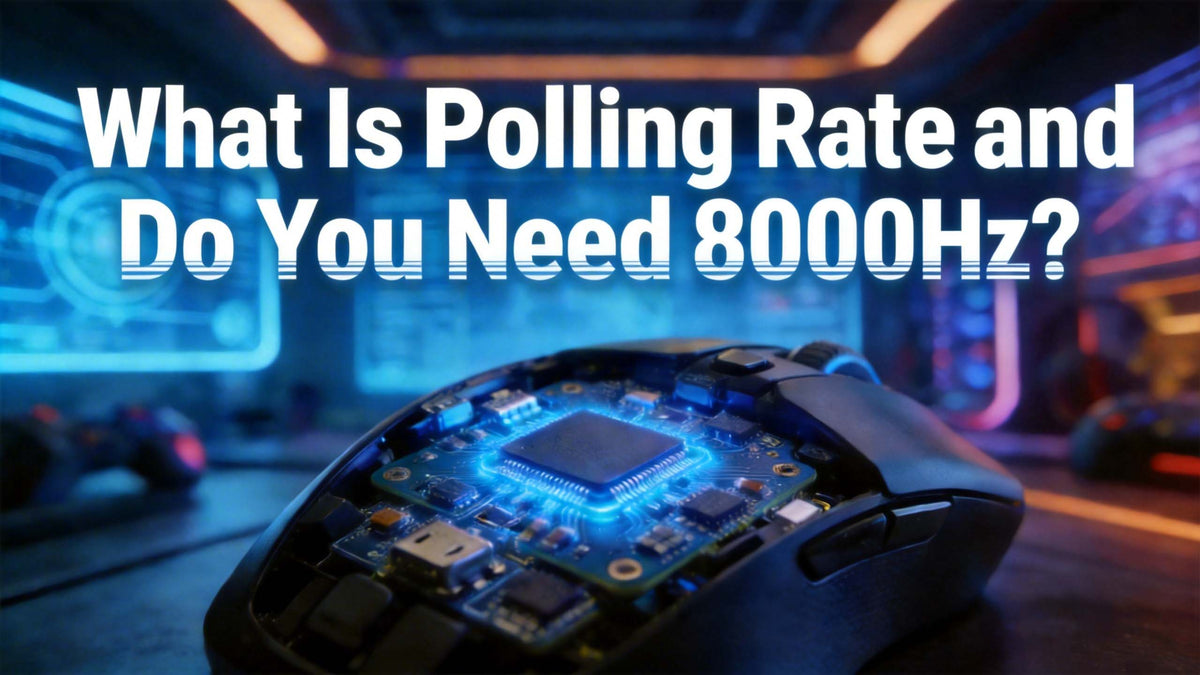
That is exactly why more players over the last couple of years have started paying attention to a term that used to sound overly technical and very “peripherals nerd”: poll rate, or more precisely, polling rate. At its core, polling rate is simply how often your mouse reports its status to your PC every second. A 1000Hz polling rate means the mouse reports 1,000 times per second. 8000Hz means 8,000 reports per second. In official explanations from brands like Razer and Logitech, the idea is straightforward: a higher polling rate means more frequent data updates and a shorter theoretical report interval. At 1000Hz, that interval is about 1ms. At 8000Hz, it drops to about 0.125ms.
For the average user, that might sound like the kind of numbers people only care about in lab tests. But for people who live in FPS games, it quickly turns into something much more relatable. It stops being about “higher specs” and starts becoming about why one mouse feels more connected to your hand than another.
Because in shooters, the moments that matter most are rarely big, dramatic numbers on a spec sheet. They are the tiny, fast, low-margin moments: the first bullet, the counter-strafe, the flick correction, the transfer, the tracking adjustment in the middle of recoil control. Nobody thinks about a data table while they are in the middle of a gunfight. But plenty of players know exactly what it feels like to lose a duel and think: I did react. I just didn’t get that motion fully into the game.
You Think You Lost on Reaction—A Lot of the Time, You Lost on Update Rate
What FPS players really care about is not whether a mouse “works.” It is whether the mouse delivered that exact movement you just made to the game fast enough.
That sounds like a small distinction, but it matters.
When we think about aiming, we tend to picture it as one smooth, continuous action. You see the enemy, flick, stop, click. In your head, it feels seamless. Inside the PC, though, it is not one uninterrupted stream. It is a chain of input data being read, transmitted, and sampled over and over again.
That is why polling rate becomes so sensitive in FPS games.
An FPS is never just about slowly dragging a cursor across a screen. In CS2, you are not casually moving your view—you are making a last-second head-level correction after a counter-strafe. In VALORANT, you are not simply shifting your crosshair—you are snapping it into a tiny danger zone the moment an opponent’s shoulder appears. In Apex, you are not just following a target—you are trying to hold a clean tracking line on someone moving at high speed while constantly changing direction.
For those kinds of inputs, it is not enough for the mouse to “send the data eventually.” What matters is whether it sends it fast enough, often enough, and fresh enough.
That is why polling rate matters so much more in a competitive shooter than it does on a desktop. A few milliseconds may not look dramatic when you are browsing, editing documents, or dragging windows around. But in high-intensity FPS situations, those tiny slices of time are often exactly where fights are won or lost.
The Most Frustrating Feeling Isn’t “Lag”—It’s “Almost”
A lot of players still think about mouse delay in very broad terms:
Does it lag?
Does it stutter?
Does it skip?
But for FPS players, the most painful problems are rarely the obvious ones that anyone can spot right away. The worst feeling is usually much subtler. It is the kind of tiny disconnect only you can feel, and once you notice it, you keep noticing it.
It shows up in little ways.
In CS2, you swing, then make a very short horizontal correction. The movement is small, but fast, and it has to stop at exactly the right moment. If your mouse is not updating that movement densely enough, the result can feel like your crosshair almost snapped into place—but not quite.
In VALORANT, you are holding a tight angle and the other player suddenly wide swings you. You are not making some huge, flashy flick. You are moving your crosshair into a very small target window in a very short amount of time. What you need in that moment is not just fast hands. You need the whole input chain to feel sharp and immediate.
In Apex, when you are tracking someone who chains a slide into a jump, the crosshair is not landing once and staying there. It is being corrected continuously. The difference polling rate makes in that situation does not usually feel like “wow, this mouse is suddenly way more powerful.” It feels more like the tracking line gets cleaner, tighter, and more connected—almost like the movement is sticking closer to your hand.
That is why so many players switch to a higher-spec mouse and, instead of describing it with engineering terms, just say something very player-like:
“This mouse feels stickier.”
That “sticky” feeling is not caused by polling rate alone, of course. But polling rate plays a very real role in it. Because what it changes is not whether the mouse can move. It changes how often your newest movement gets reported to the PC. The more frequently the mouse reports, the easier it is for the system to work with the version of your motion you just made—not the slightly older version from a moment ago.
So when players talk about a mouse feeling more locked-in, more responsive, or more glued to their aim, they are often describing the effect of several things working together—and polling rate is one of them.
Polling Rate Is Not Just One Number—It Depends on an Entire Hardware Chain
A lot of consumers first hear about polling rate and instinctively assume something simple:
better sensor = higher polling rate.
But that is not really how mouse design works.
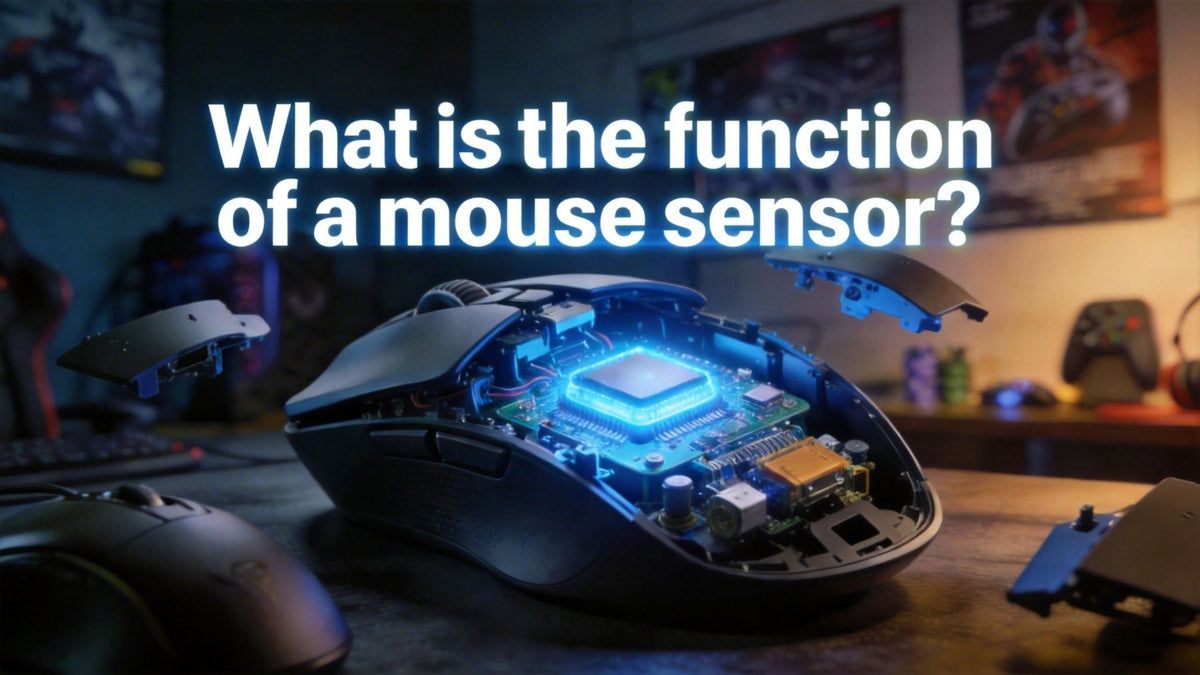
The sensor absolutely matters. It is what reads your movement on the mousepad and determines whether the mouse can maintain reliable tracking during fast flicks, abrupt stops, large-angle swipes, or hard acceleration changes. A good sensor helps make sure the mouse does not lose the plot when your hand gets aggressive.
But polling rate is not the sensor’s job alone.
It is really the result of the whole internal input pipeline working together. The sensor captures movement. The main MCU processes it. The firmware schedules it. USB or wireless transmission carries it. Then the PC and the game still have to read and sample it on the other side.
That is an important distinction, because it explains why high polling rate is not something one component can magically deliver by itself. It is not about a single part jumping out and carrying the whole system. The mouse has to keep up all the way through—from capture to processing to transmission.
That is also why people who really understand the best gaming mice today are no longer just staring at DPI numbers.
DPI is easy to turn into a flashy marketing bullet. But real competitive performance is not determined by whether a number looks big on the box. It is determined by whether the entire chain behind that number is stable. You can make a spec sheet look insane, but if the MCU is not strong enough, the firmware is not mature enough, or the wireless implementation is not stable enough, then a high polling rate can end up being more impressive on paper than it is in actual gameplay.
A genuinely good experience is not “this mouse says 8000Hz.”
It is “this mouse still feels stable, consistent, and clean even when it’s running at a very high rate.”
Why FPS Players Care More Than Everyone Else
Because shooters depend more than almost any other genre on that last little piece of execution.
Inputs matter in MOBAs, RPGs, and open-world games too, obviously. But those games rarely compress success and failure into such brutally small windows. FPS games do. That is part of what makes them exciting, and part of what makes them cruel.
In a lot of gunfights, you do not really get a second try.
That is especially true in games like CS2, where first-bullet accuracy carries enormous value. Very often, a duel is not decided by who made more movements. It is decided by who delivered the most important micro-adjustment earlier and cleaner. Maybe it is a tiny correction. Maybe it is the final stop before the shot breaks. Maybe it is a transfer onto a second target in the middle of recoil. Those are exactly the kinds of small motions that suffer the most when updates are not arriving fast enough.
And modern FPS games are only making that more obvious.
Competitive displays are getting faster. 240Hz and 360Hz panels are no longer niche. Players are much more aware of input latency than they were a few years ago. System-level optimizations and low-latency technologies have kept pushing the whole chain forward. Once that happens, the mouse naturally gets dragged into the same race.
That is why higher polling rates have become more visible in the conversation. Not because players suddenly wanted one more spec to argue about, but because the competitive scene keeps demanding tighter and tighter input timing. From a player’s point of view, that is easy to understand. You may never sit there measuring milliseconds with test software every day. But you will absolutely notice whether a mouse makes you feel more stable in stressful gunfights.
And that is what people are really buying.
Most players are not shopping for high-end mice because they want a new cool gadget to put on the desk. They are buying because they know that in the games they care about most, those tiny differences in feel eventually become differences in consistency, confidence, and results.

So, Do You Actually Need 8000Hz Polling Rate?
From a player’s perspective, the honest answer is not extreme.
8000Hz does have real value. It is not a made-up feature. On paper, the advantage is simple: compared with 1000Hz, an 8000Hz mouse reports far more frequently and reduces the theoretical gap between updates from about 1ms to about 0.125ms. From the standpoint of pure input freshness, that is a meaningful step forward.
But it is not a magic switch that works independently of everything else.
A higher polling rate does not exist in a vacuum. The mouse still feeds into the rest of the system. Your monitor refresh rate, your frame rate, your CPU behavior, your drivers, and the game engine itself all affect whether you will truly feel the benefit. That is why 8000Hz is better understood as a higher-tier capability, not an automatic win button.
If your everyday environment is a high-refresh, high-frame-rate, competitive FPS setup, then the value of a higher polling rate becomes much more concrete. If the rest of your system is not fully keeping up—or if your use case simply does not demand that level of input density—then 1000Hz can still be a stable, mature, and perfectly sensible balance point.
That is the more realistic way to look at it.
The mature take is not “8000Hz is overrated.”
And it is not “1000Hz is obsolete.”
It is that the meaning of higher polling rate becomes clearer the more your setup and your games are actually positioned to take advantage of it.
That is also why competition in today’s best gaming mice is no longer just about lightweight shells, RGB, or flashy industrial design. More and more of the real differentiation is happening deeper in the input stack. Because what players care about is not whether the packaging can print a bigger number. It is whether the move they just made with their hand arrives on screen more completely.
FPS Players Aren’t Really Buying Specs—They’re Buying Fewer Regrets
So let’s go back to the question:
What is polling rate, and do you need 8000Hz?
If you explain it in the most player-friendly way possible, it is actually pretty simple. Polling rate determines how often your mouse tells your computer what you just did. For everyday use, that may mostly show up as a matter of smoothness. But for FPS players, it is closer to a form of timing control. It decides how quickly that stop, flick, correction, or transfer can enter the game.
It will not teach you crosshair placement.
It will not fix your recoil control.
It will not turn every player into a highlight reel overnight.
But it does help explain something a lot of players have already felt for a long time, even if they did not have the words for it.
Why some mice always leave you thinking, I swear I did that.
Why some mice feel like the crosshair is more directly connected to your hand.
Why discussions around poll rate and polling rate are no longer just niche spec talk, but a real part of how performance-focused brands talk about their products.
Because in the end, FPS players are not really buying numbers.
They are buying a gunfight that feels a little less regrettable.
They are buying the confidence that this time, that motion actually got there.
They are buying one less moment where they lose the round and feel like they were late by half a beat.

Leave a comment
All comments are moderated before being published.
This site is protected by hCaptcha and the hCaptcha Privacy Policy and Terms of Service apply.