

Lately, I’ve been playing a lot of Call of Duty, and my girlfriend still doesn’t really understand why I spend so much of my time gaming. One time, she asked me why I like FPS games so much.
My first reaction was pretty simple. I love the feeling of getting better at aiming. I love those clutch moments when you win a fight you probably shouldn’t have won. I love the clean headshots, the lucky headshots, and that sudden adrenaline rush when you close out a round. And it’s not just about playing alone, either. A lot of the fun comes from being in voice chat with friends, calling out positions, making plans, and just talking while the match is going on. That’s the classic appeal of FPS games, and honestly, it’s still the core of what makes them so good. In a shooter, you’re constantly reading angles, making decisions off information, and adjusting your reactions in real time. That tension is what makes the genre so compelling.
But if you’ve played long enough, you start to realize that the joy FPS games bring isn’t limited to those things alone.
I’ve felt that pretty clearly myself. When you first get into a new game, the sense of freshness is strong. You don’t know if someone’s going to swing the next corner. You don’t know which site the enemy likes to rush. You don’t know how the round is going to change after one smoke goes down. Every step feels uncertain, and because of that, every match feels exciting.
But once you know a map inside and out, a lot of that becomes predictable. You know the standard enemy positions. You know which angles people love to hold. You know exactly which route to take if you want to flank from behind, which spots to avoid, and what timing gives you the best chance of catching someone off guard. The more familiar you get with the map, the positions, and the pace of the game, the more that original sense of tension starts to fade. The game is still fun, but that raw excitement isn’t always as strong as it was at the beginning.
At that point, the game itself is still there, but the emotional high doesn’t always hit the same way.
Later on, I realized that some of my happiest moments weren’t even about hitting the cleanest shot. They were about playing with friends. Calling things out, making mistakes, roasting each other, and sometimes pulling off a weird play that somehow works because everyone is on the same wavelength. That kind of fun feels real. It’s not built purely on winning or losing. It comes from shared participation.
But real life makes that harder. Friends aren’t always free. Once you start working, everyone has their own schedule, their own pressure, and their own responsibilities. It gets a lot harder to line up time the way you could back in school. You want to queue a game, and one friend is still at work. By the time you’re finally free, somebody else is already getting ready for bed. So a lot of the time, you end up logging on alone, queuing alone, and playing a full match by yourself.
When I realized that every time I logged in, the only profile in my friends list showing “online” was mine, it hit me that gaming had slowly become something that only gave me one kind of joy: competition.
I Don’t Want Gaming to Become Pure Competition
I know saying that might get some pushback. And to be fair, I’m not denying that the desire to win is part of what makes competitive games exciting in the first place. Winning matters. Gaining an advantage matters. Closing out a key duel in a critical moment is absolutely part of what makes FPS games so addictive.
But I’m not a professional player, and I don’t think gaming should be reduced to just one goal: winning.
If the only reason I play is to win, then gaming starts to feel a lot like work. The moment winning becomes the only acceptable outcome, the game stops being a place to relax and immerse myself, and starts feeling like a task I have to complete. I begin carrying pressure into every round. I stop being able to accept failure honestly and casually. Instead of thinking, “This next game could be fun,” I start thinking, “I absolutely cannot lose this one.”
And once you’re in that mindset, your emotions start to change. You put pressure on your teammates without even realizing it. You become more sensitive to other people’s mistakes. Something that was supposed to be entertainment slowly turns into this exhausting process of proving something to yourself. And in the end, even when you win, it doesn’t always feel that satisfying. But if you lose, it can ruin your whole night.
That’s not the kind of gaming experience I want.
I want competition to be part of the experience, not the entire experience. I still want to care. I still want to improve. But I also want to keep my ability to enjoy the process.
So when I realized that the way I was getting joy from games had become too narrow—and honestly, kind of unhealthy—I knew I had two choices: either step away, or find a new way to reconnect with the fun.
Vertical Gaming Mouse for FPS
I like collecting mice. I’ll even match different mice to different kinds of games or playstyles. On my display shelf right now, I have the Razer Viper V4 Pro and the Logitech G PRO X SUPERLIGHT 2 DEX as two of my main picks.
The V4 Pro feels noticeably lighter. It starts and stops more sharply, and when I’m doing fast horizontal flicks, snap shots, or tiny micro-adjustments, it feels incredibly responsive. I tend to prefer it for Valorant and CS2. The Logitech G PRO, on the other hand, gives me a little more support in the hand. My palm doesn’t feel like it’s floating, and that makes it a better fit for games like Apex Legends and Call of Duty.
Lately, though, I’ve realized that a mouse can offer me something beyond just performance. It can also bring back a sense of novelty and fun.
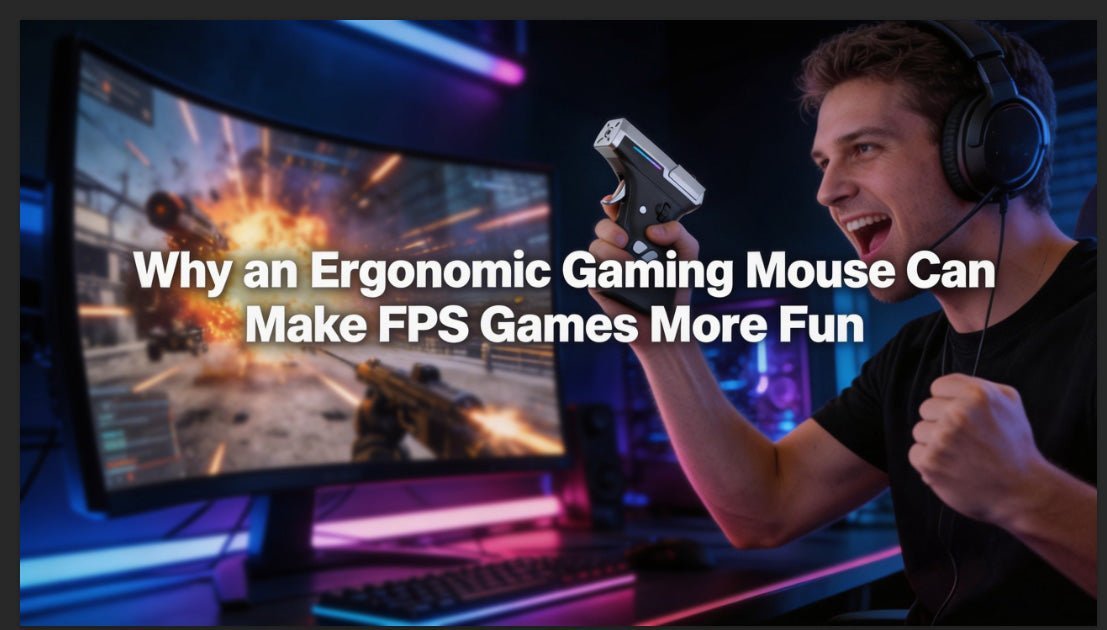
The ErgoStrike7 is an ergonomic gaming mouse, but it doesn’t look like what most people picture when they hear “ergonomic mouse.” Instead of following the usual desktop-mouse design language, it builds on a vertical-mouse foundation and adds the visual style and grip logic of a Glock-style pistol. The result is something that looks more like a handgun, or maybe even a controller you’d expect to see with a console accessory. The first time most people see it, they pause for a second, because it doesn’t fully match the usual public idea of what a mouse is supposed to look like.
And that’s exactly what makes it interesting.
The Grip on the ErgoStrike7 Feels Genuinely Unusual
The vertical structure changes your hand posture immediately, so the experience already feels different from using a traditional flat mouse. Then the Glock-inspired shape pushes that one step further, because it connects the act of holding the mouse to the mental image of shooting in an FPS game.
What makes it even more interesting is the added recoil vibration module. Every time I pull the trigger to fire, the recoil module vibrates in sync with the action. It creates a feedback loop that feels surprisingly close to the sensation of actually firing something. That’s probably my favorite part of the whole design.
At first, though, it was definitely not something I was instantly comfortable with.
On a traditional mouse, the center of control sits more in your palm. Most of us are used to feeling the mouse’s position, direction, and tiny movements through the palm because our hand rests on top of it. That’s the control logic we’ve built up over years of use. But the ErgoStrike7 doesn’t work like that. It feels more like your hand is gripping a device rather than covering one.
That changes a lot. The way your hand applies force changes. The place where you sense the center of balance changes. Even your understanding of the relationship between movement and click timing starts to shift. My first instinct was to control it the same way I control a normal mouse, but it quickly became obvious that these two devices do not operate on the exact same interaction logic.
And because of that, my crosshair was constantly drifting. Flick shots that normally felt automatic suddenly felt off. My spray control didn’t behave the way I expected. A lot of the muscle memory I had built with traditional mice just didn’t transfer over cleanly.
But while I was adjusting, I also noticed something else.
Back when I used a traditional mouse, three hours of gaming would often leave my arm sore enough to really feel it. With the ErgoStrike7, I could still play for three hours, but without the same level of discomfort. To me, that made the ergonomic side of the design feel genuinely scientific and effective, not just like a marketing label.
As I kept adapting to it, I also found little techniques that helped. I started using the three fingers closer to the sensor area to feel where the crosshair really was, while leaving the trigger action to my index finger. Once I shifted that sense of control from my palm to those three fingers, the experience became much easier to accept. And more importantly, it became fun.
That’s really the point.
With the ErgoStrike7, I wasn’t just getting a different mouse shape. I was getting a different way to engage with the game. I still got the ergonomic posture benefits, but I also got something extra: a more immersive feeling when firing, and a stronger sense of involvement every time I played.
And one of the strangest things I noticed was this: if you play Valorant, then you already know that the Sheriff and the Ghost feel completely different as pistols, both in damage and in rhythm. I used to struggle to fully capitalize on them, especially in tense situations. But now I find myself buying them a lot more often—especially the Sheriff, even when it’s not technically an eco round. I’m not saying the mouse magically turned me into a pistol god. But it did make those weapons feel more engaging to use, and that changed how often I wanted to play around with them.
What I Was Really Missing Wasn’t Just Better Hardware—It Was a Better Feeling
Some people want a higher win rate. Some people want better hand feel. Some people want the social side of gaming. Some people just want that sense of freshness again. But those needs don’t actually conflict with each other.
A well-rounded gaming experience should have room for competition, social connection, and immersion at the same time.
For me, gaming is supposed to help me relax and release pressure. It’s supposed to be something I can sink into, not just something that measures whether I performed well enough that night. And if you’ve reached a similar point—if you still love FPS games, but you also feel like you’re looking for a different kind of enjoyment, or if you just naturally pay attention to cool gaming gadgets—then a product like the Ragnok ergonomic mouse might be worth checking out.


Leave a comment
All comments are moderated before being published.
This site is protected by hCaptcha and the hCaptcha Privacy Policy and Terms of Service apply.